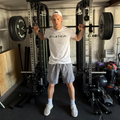




Bumper Plates are the first choice in 2026 for most Garage Gyms and for anyone doing Olympic weightlifting or functional training. They protect your floor, cut noise massively and let you drop safely. Here you'll find out which Bumper Plates are actually worth buying in 2026 and what to look for.

The short answer up front
For most Garage Gym users and weightlifters, high-quality standard Bumper Plates with a tight weight tolerance and solid rubber or urethane quality are the best pick.
If you train outdoors regularly, go for dedicated outdoor or High-Temp bumpers. If you want maximum precision, choose Competition Plates. For everyday Garage Gym training, good Color or standard bumpers are plenty.
What makes a good Bumper Plate in 2026
The quality criteria that matter most:
- Weight tolerance under 1–2%
- Uniform outer diameter (usually 17.7" / 450 mm) regardless of weight
- Solid steel insert firmly bonded to the rubber/urethane
- Shore hardness that allows a controlled bounce (not too soft, not too hard)
- Low odor and REACH compliance
- Good surface grip for handling
- Durability over repeated drops
One more thing that matters: whether the plates are made for indoor, outdoor or both.
The main bumper types at a glance
|
Type |
Best use |
Pros |
Cons |
Recommended for |
|
Garage Gym, functional, weightlifting |
Great value for money, color-coded |
Medium bounce |
Most users |
|
|
Competition, precision training |
Very tight tolerance, low bounce |
Pricier |
Advanced lifters & competitors |
|
|
High-Temp / Outdoor Bumper |
Outdoor training, extreme temperatures |
UV- and heat-resistant, weatherproof |
Often pricier |
Outdoor athletes |
|
Garage Gym + handling |
Grip holes, often more compact, durable |
Slightly pricier |
Anyone who wants easy handling |
|
|
Budget bumper |
Getting started |
Cheap |
Worse tolerance & durability |
Short-term only |

What to pay extra attention to in 2026
1. Weight tolerance
The tighter the better. Good plates stay within 1–2% deviation at most.
2. Material
Urethane is usually more odor-neutral and more resistant than standard rubber. High-Temp compounds handle heat and UV far better.
3. Bounce behavior
Plates that are too soft bounce unpredictably. Plates that are too hard put more stress on your floor and your bar. A medium, controlled bounce is ideal.
4. Thickness and loading capacity
Bumpers are thicker than Iron Plates. On very heavy sets, the sleeve space on the bar can become the limiting factor – that's when it makes sense to combine them with Iron Plates.
5. Outdoor suitability
Regular bumpers suffer under constant UV exposure and temperature swings. Dedicated outdoor or High-Temp versions are clearly superior here.
Recommended set sizes for 2026
Beginner / Garage Gym:
230–350 lb (e. g. 2×55 lb, 2×45 lb, 2×35 lb, 2×25 lb, 2×10 lb)
Advanced / weightlifting:
350–430 lb + fractional plates for finer jumps
Heavy training:
430 lb+ and, if needed, Iron Plates on top for maximum load on the bar

Bumper Plates vs. Iron Plates – the combination that makes sense
For most athletes in 2026, the best solution is a mix:
- Bumper Plates as your base (floor protection, noise reduction, safe drops)
- Iron Plates on top for heavy sets where bumper thickness becomes the limit
That way you keep the advantages of both systems.
Common mistakes when buying Bumper Plates
- Buying plates that are too cheap, with poor tolerance and a strong smell
- Training outdoors with regular indoor bumpers
- Picking a set that's too small and then constantly buying more
- Underestimating the thickness and running into loading problems later
- Using no mats underneath the bumpers
Frequently asked questions about Bumper Plates in 2026
Do you need expensive Competition bumpers in a Garage Gym?
No. For most users, good standard or Color bumpers are perfectly enough. Competition plates pay off mainly if you have competition ambitions or want maximum precision.
Can I use Bumper Plates for powerlifting too?
Yes. The only downside is the greater thickness. On very heavy sets that's why people often combine them with Iron Plates.
How loud are good Bumper Plates really?
Far quieter than Iron Plates. Combined with good floor protection mats, training becomes acceptable even in an apartment.
Do outdoor bumpers make sense indoors too?
Yes. They're usually tougher and last longer, but they often cost more.
Which Shore hardness is ideal?
A middle range that allows a controlled bounce without being too hard or too soft. Extremely soft plates aren't suited to regular training.

Key Takeaways
- Good Bumper Plates are the best foundation for a Garage Gym and weightlifting in 2026.
- Look for tight weight tolerance, a solid insert and high-grade material.
- Standard/Color bumpers are enough for most people.
- High-Temp / Outdoor Bumper versions are a must for permanent open-air training.
- A smart mix of bumpers + Iron Plates solves the thickness problem on heavy sets.
- Don't cut corners in the wrong place – bad bumpers cause more trouble in the long run than they save.
Your next step
Want to find the best Bumper Plates for your training?
Compare the current Atletica Bumper, Color, High-Temp, Gripper and Outdoor versions. With tight tolerance, rugged build quality and solid everyday usability, you're set up for the long haul.
Book a free consultation and put together your ideal bumper set.